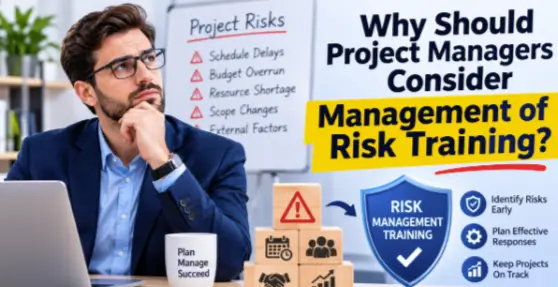
Project management requires more than assigning tasks, meeting deadlines, and controlling budgets. Projects often face unexpected challenges, such as rising costs, resource shortages, supplier issues, and changing business requirements. Professionals need the ability to identify potential risks, evaluate their impact, and develop effective response plans. A PRINCE2 Risk Management Course helps project managers develop structured approaches to handling uncertainty and making informed decisions. These skills improve project control, strengthen communication, and support better resource management. Developing risk management capabilities also enhances professional confidence and helps organisations achieve their project objectives successfully.
How Does Management of Risk Training Help Project Managers Identify Potential Threats?
Identifying potential risks before they affect project activities is an essential responsibility for project managers. Challenges may arise from financial planning, technology, suppliers, employees, or changing business conditions. Recognising these threats early allows teams to prepare suitable responses and minimise disruptions. PRINCE2 Risk Management Training helps professionals develop practical skills for identifying uncertainties, analysing potential threats, and maintaining accurate risk records. These techniques enable project managers to make informed decisions, manage uncertainties effectively, and maintain better control throughout different project stages.
Understanding Different Types of Project Risks
Project risks can come from financial difficulties, technical failures, resource shortages, and regulatory changes. They may also involve communication problems or disagreements between stakeholders. Understanding these categories helps project managers consider different situations that could affect their objectives. Structured learning also helps professionals recognise positive uncertainties that may create opportunities. By considering both threats and opportunities, managers can make balanced decisions and prepare their teams for different possible outcomes.
Recognising Early Warning Signs
Many project problems develop gradually rather than appearing suddenly. Repeated delays may indicate poor scheduling, while increasing expenses could suggest budget difficulties. Similarly, communication gaps between departments may create misunderstandings that affect project progress. Through Management of Risk Training, professionals learn to recognise warning signs and investigate their possible causes. They can collect information, consult team members, and review project activities. Early identification allows managers to take action before minor issues become serious challenges.
see also: Commercial Movers in West Roxbury, MA: Business Relocation with Minimal Disruption
Creating a Consistent Risk Identification Process
Risk identification becomes more effective when everyone follows a clear approach. Project managers can involve employees, suppliers, clients, and stakeholders to gather information about possible threats. Brainstorming, interviews, workshops, and previous project reviews can help identify important concerns. A consistent process also makes responsibilities clearer. Team members understand when to report potential problems and whom to inform. This encourages communication and helps organisations make risk identification part of everyday project activities.
Why Is Risk Assessment Important for Better Project Decision-Making?
Identifying risks is just the beginning of effective risk management. Project managers must evaluate how likely each risk is to occur and understand its potential impact on project outcomes. While some risks may cause minor disruptions, others can affect budgets, deadlines, and overall objectives. A structured assessment helps professionals prioritise concerns, allocate resources effectively, and make informed decisions. A PRINCE2 Risk Management Course can help develop the knowledge needed to assess risks and manage project uncertainty more effectively.
Evaluating Risk Likelihood and Impact
Risk assessment involves examining the possibility of an event occurring and its potential consequences. For example, a supplier delay may affect delivery if alternative materials are unavailable. Similarly, unexpected operating costs could place pressure on the approved budget.
Prioritising Risks According to Their Severity
Not every identified risk requires immediate action. Some concerns can be monitored through regular reviews, while others may need attention from senior management. Prioritising risks helps project managers focus their resources on issues that could have the greatest impact. Risk matrices and impact assessments can support this process. They provide a clearer picture of which threats deserve attention. This also helps managers explain decisions to stakeholders and allocate resources according to project requirements.
Supporting Better Business Decisions
Project managers often make decisions without complete information. They may need to select suppliers, approve additional expenses, change schedules, or adjust project plans. Understanding potential risks helps them compare available options before making commitments.
How Can Risk Management Skills Improve Project Control and Delivery?
Effective project control depends on regularly monitoring activities, resources, deadlines, and changing requirements. Unexpected challenges can arise even when projects follow well-prepared plans. Project managers must therefore respond to risks while keeping their objectives on track. PRINCE2 Risk Management Training helps professionals develop the skills to identify potential threats, assess their impact, and plan appropriate responses. These capabilities improve communication, strengthen coordination, and help organisations maintain project progress throughout the project lifecycle.
Developing Practical Risk Response Strategies
After identifying and assessing a risk, project managers must decide how to handle it. Common strategies include avoiding a threat, reducing its likelihood or impact, transferring responsibility, or accepting it when appropriate. Opportunities can also be enhanced or exploited. PRINCE2 Risk Management Training helps professionals understand how to select suitable responses. For example, managers facing possible supplier delays may arrange alternative suppliers or adjust delivery schedules. Choosing the right response depends on the seriousness of the risk, available resources, and organisational requirements.
Maintaining Effective Risk Monitoring and Reporting
Risk management should continue throughout a project’s lifecycle. New problems may appear, existing risks may become more serious, and previously identified concerns may no longer require attention. Regular monitoring helps project managers understand whether planned actions are working.
Improving Communication and Team Collaboration
Managing risks effectively requires cooperation. Project managers need information from employees, suppliers, clients, and senior stakeholders to understand possible problems. Clear communication helps teams report concerns and discuss suitable solutions. A supportive working environment encourages employees to raise issues without hesitation. When responsibilities are properly defined, everyone understands their role in managing uncertainty. Better collaboration reduces misunderstandings and helps teams respond to challenges more efficiently, supporting consistent project performance.
Can Management of Risk Training Support Long-Term Career Growth?
Professional development helps project managers prepare for greater responsibilities and changing workplace requirements. Organisations need professionals who can understand uncertainty, support important decisions, and protect business objectives. Developing risk management knowledge can strengthen an individual’s professional profile and improve workplace abilities. It can also create opportunities in project management, programme management, and business operations. Recognised qualifications provide structured learning that helps professionals understand established approaches and apply them to different organisational situations.
Building Recognised Professional Knowledge
Professional qualifications help individuals develop knowledge of risk management principles and techniques. They cover important areas such as risk identification, assessment, response planning, communication, and monitoring. These skills are useful for professionals working with projects of different sizes and complexities. Management of Risk Training provides a learning pathway for individuals interested in understanding uncertainty across organisational activities. Tecknologia offers professional training opportunities that help learners develop relevant project and risk management knowledge through suitable learning options.
Strengthening Leadership and Problem-Solving Abilities
Project managers regularly face situations that require careful judgement and practical problem-solving. They may need to resolve disagreements, manage limited resources, respond to changing requirements, or explain important decisions to stakeholders. Developing risk management knowledge helps professionals examine different possibilities before taking action. It also improves their ability to communicate recommendations and guide teams through challenging situations. These capabilities are valuable for programme managers, PMO specialists, operational managers, and other professionals responsible for organisational performance.
Understanding the Updated Certification Pathway
The updated PRINCE2 Risk Management framework replaces the former Management of Risk (M_o_R) qualification terminology. It places greater emphasis on people, organisational culture, and managing uncertainty across different business perspectives. Professionals considering a PRINCE2 Risk Management Course should check the current syllabus, certification level, examination requirements, and available learning options. Tecknologia provides professional development opportunities for individuals interested in strengthening their project and risk management knowledge. The right learning pathway can help professionals apply structured techniques to practical workplace situations.
Conclusion
Successful project management requires professionals to identify uncertainty, assess potential consequences, and prepare suitable responses. Developing structured risk management knowledge helps project managers improve decision-making, strengthen communication, and maintain control over project activities. It also supports career development by building practical skills valued across different industries. Professional learning provides useful methods for handling workplace challenges and protecting organisational objectives. Investing in relevant knowledge can benefit individuals and organisations, helping teams manage uncertainty, use resources effectively, and deliver projects with greater confidence.